Tekor—the oldest Armenian basilica in eastern Turkey
The Tekor Basilica (Tekor Bazilikası), also known as the Church of Saint Sarkis, is one of the earliest and most enigmatic Christian churches in Eastern Anatolia. It is located in the province of Kars, in the small village of Digor, a few dozen kilometers from the ruins of the medieval Armenian capital of Ani. Built in the 5th century, the basilica is considered one of the oldest dated stone churches in modern-day Turkey and a major monument of early Armenian architecture. Until the devastating earthquake of 1912, Tekor remained virtually untouched for over 1,500 years, and it was its architectural design that formed the basis of the classic Armenian domed church. Today, only fragments of the walls and the apse remain of the basilica, but even these make a strong impression and attract pilgrims, historians, and enthusiasts of early Christian archaeology.
History and Origin
The emergence of Tekor is linked to the era of the Christianization of Armenia and the Caucasus. After Armenia became the first country in the world to adopt Christianity as its state religion in the early 4th century, active church construction began throughout its lands. According to surviving inscriptions and accounts by Armenian historians, the basilica in the village of Digor was erected in the late 5th century by the noble Kamsarakans—one of the most influential nakharar dynasties that ruled the lands of Arsharunik. The church was dedicated to Saint Sarkis, a warrior-martyr revered in the Armenian tradition.
An ancient Greek inscription on the tympanum of the southern entrance mentioned the name of Bishop John and the nakharars involved in the construction, and was considered one of the oldest dated epigraphic monuments in Armenia. Throughout the Middle Ages, Tekor remained an active church and a place of pilgrimage, enduring changes in political rule—from Arab caliphs to the Seljuks, Mongols, Ottomans, and Russian garrisons of the late 19th century. In the 19th century, European researchers, including Nikolai Marr and the French archaeologist Charles Dill, took notice of the monument.
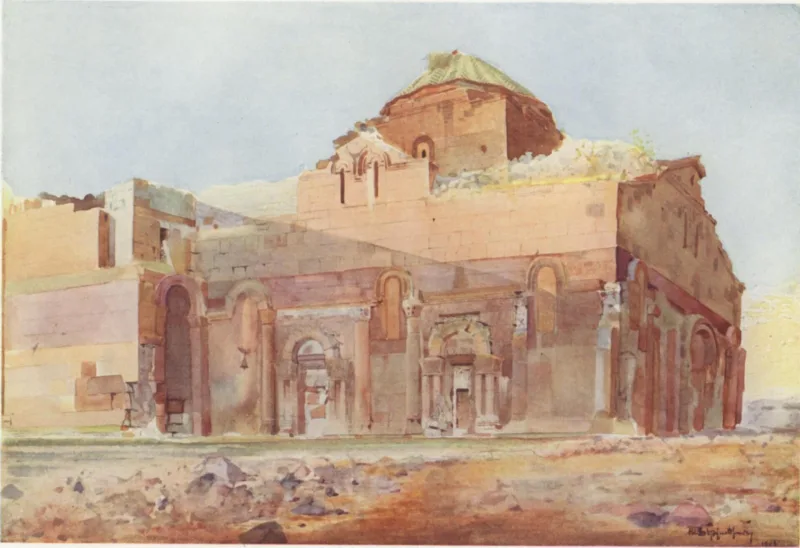
A decisive moment in the basilica’s fate was the devastating earthquake of 1912: it brought down the dome drum and most of the vault, reducing the church to ruins. Following the depopulation of the region’s Armenian population in the early 20th century, Tekor was left without a congregation. During the Soviet and subsequently the Turkish periods, the monument gradually fell into disrepair and was used by local residents as a source of building stone; today, its surviving fragments are included in Turkey’s list of protected sites, although no major restoration has yet been carried out.
Architecture and What to See
Despite the destruction, Tekor retains a recognizable layout and remains a rare example of the transition from an early Christian three-aisled basilica to the domed composition characteristic of later Armenian architecture. The church was built of hewn tuff in a warm yellow-pink hue, typical of the Kars and Ani regions.
Plan and General Composition
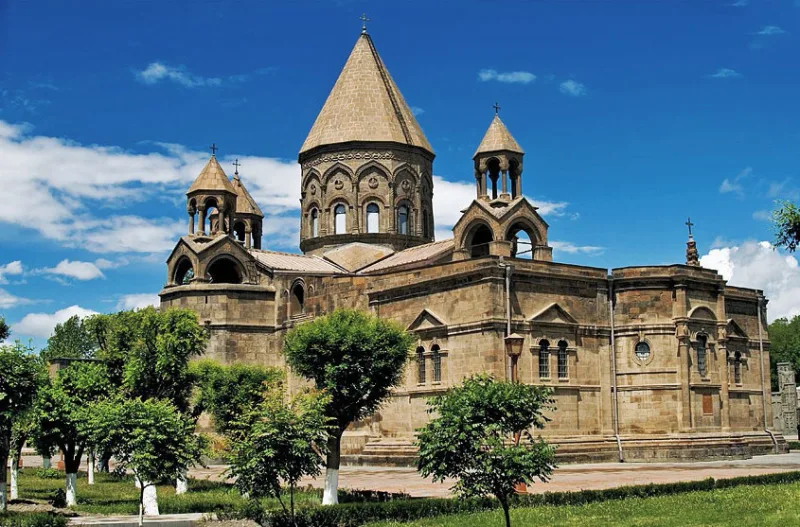
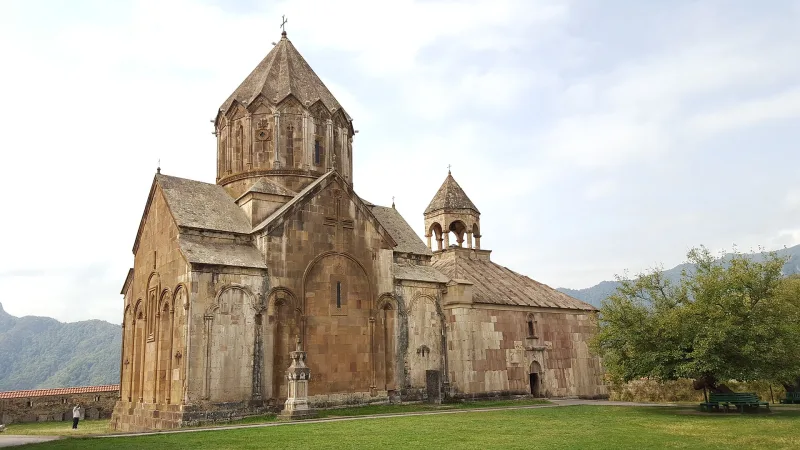
The basilica has an elongated rectangular plan, approximately 30 meters long and 16 meters wide. Inside, it is divided by two rows of massive columns into three naves: a wide central nave and two narrow side naves. A dome rose above the crossing on a low octagonal drum—it is this detail that makes Tekor a unique monument, as a dome in an early Christian 5th-century basilica is extremely rare. The architects combined the traditional Roman-Syrian basilica form with a local preference for a centric composition.
Eastern facade and apse
The eastern part of the church, with its semicircular apse flanked by two side chapels (pastophoria), is the best-preserved section. On the exterior of the apse, characteristic Armenian triangular niches are visible, which would later become one of the hallmarks of the churches of Ani and Akhtamar. The masonry consists of perfectly fitted stone blocks with thin joints, indicating a high level of craftsmanship.
South Portal and Inscriptions
The main entrance to the basilica was located on the south side. Until 1912, a stone tympanum with a carved inscription, considered one of Armenia’s key epigraphic monuments, remained above the entrance. After the earthquake, the tympanum was lost; only its sketches and photographs from the late 19th century are known. The carved geometric and floral ornaments on the surviving fragments of the door jambs resemble the ornamentation of early Syrian and Mesopotamian Christian churches.
Dome and Interior
The basilica’s dome, which collapsed during the earthquake, rested on four free-standing pillars and a system of stepped trompes. This design is considered one of the earliest in the history of world architecture: the ribbed dome structure, adopted from here into the Byzantine and Georgian traditions, forms the basis of most domed churches in the South Caucasus. Inside, the walls were plastered and partially painted with frescoes; the paintings are known from fragments described by pre-revolutionary researchers.
Surrounding Landscape
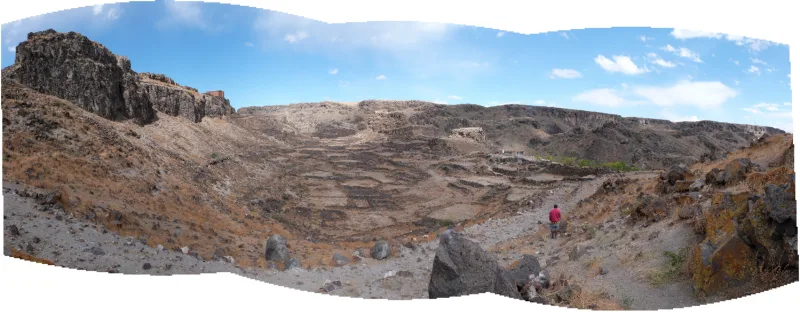
The basilica stands on a gentle hill above the Digor-Chay River valley, amidst grassy pastures. The hill offers a panoramic view of a rocky plateau dotted with khachkars, the remains of medieval dwellings, and a cemetery. This creates a unique atmosphere of authentic, untouched antiquity, very different from the more “polished” museum sites in Turkey.
Interesting Facts and Legends
- The tympanum of Tekor’s southern portal, bearing a 5th-century inscription, is considered the first dated architectural monument of Armenian Christian architecture; its loss in 1912 is regarded by experts as one of the greatest losses to the history of Transcaucasian architecture.
- The dome-on-trumpets construction used in Tekora influenced the architecture of Jvari in Georgia, the Church of the Holy Cross at Akhtamar, and many churches in Ani.
- In popular memory, the basilica is called “Tigranakert-kilisesi” based on the legend that it was founded by a descendant of the Armenian king Tigran the Great; historically, the connection to Tigran has not been confirmed.
- In 1875, the French traveler Benoît de La Mellery wrote that Tekor “gives the impression of a temple abandoned by people but not by God”—a phrase that has become a classic in literature.
- The 1912 earthquake, which brought down the dome, was felt from Tiflis to Erzurum and became the subject of seismological research by the Russian Imperial Academy of Sciences.
- Until the early 20th century, local Kurdish Yazidis considered the ruins of Tekor a sacred site and came here to perform rituals associated with the veneration of water and the sun.
- In the 2010s, a group of Armenian and Turkish architects developed a conservation project for the monument, but work has stalled at the documentation stage; the monument continues to deteriorate.
How to get there
Tekor is located near the village of Digor in Kars Province, approximately 70 km southeast of the city of Kars and 40 km south of the ruins of Ani. The most convenient route starts in Kars: minibuses (dolmus) run regularly from there to Digor. The journey takes about 1.5 hours along a paved but winding mountain road. From the center of Digor to the basilica, it is about a 1 km walk along a dirt path; look for a hill with a solitary stone apse.
For drivers, it is most convenient to combine the trip with a visit to Ani and the border village of Olti. The scheduled bus from Kars to the village of Tuzje passes by Digor but stops on request. In winter, the road is often snow-covered, so the best time to visit is from May to October. There are no signs pointing to the basilica; it is recommended to download the coordinates to an offline map in advance.
Tips for travelers
Tekor is a site for independent and well-prepared travelers. There is no ticket office, fencing, tickets, infrastructure, or security. The monument is open 24 hours a day, but it’s best to explore it in daylight—the stone blocks are slippery after rain, and inside the surviving walls there are many debris and holes in the floor.
Bring water, a hat, and sturdy shoes: the climb from the road is short but rocky. Be sure to bring a wide-angle camera—the basilica’s apse and the valley panorama are photogenic in the morning and evening light. The best time to visit is from May to June, when the valley is green and in bloom, and in September, when the air is clear. In July and August, the plateau can be very hot and dusty.
It makes sense to combine a visit to Tekor with a tour of the region’s Armenian heritage sites: the ruins of Ani, the church in Khtskonk, the Magazberd Fortress, and the Kars Citadel. A full day on this route covers about 200 km, so it’s more convenient to travel by rental car or as part of a small group with a guide. Respect the site: do not chip off anything, do not write on the walls, and do not touch the preserved carved fragments—every stone here is unique.
From Kars, it’s worth setting aside a separate day to explore the local cuisine: try Kars “gravier” cheese, smoked goose (kaz tandır), mountain clover honey, and thick “sutsma” yogurt. These foods perfectly complement a trip to the east, and in the village of Digor, there are a couple of modest tea houses serving fresh bread and strong tea. Be prepared for simple but sincere hospitality. And be sure to keep in mind: this is a border region, so notifying your hotel of your itinerary and carrying your passport are not mere formalities, but safety precautions and a matter of good manners.